Showing posts with label biology. Show all posts

Saturday, July 18, 2015

The More I Learn, the Less I Know

Wow, how time files! It's mid-July already and my girls are chugging right along.

The week before last was the annual conference of the Heartland Apicultural Society, which is the end-all, bee-all for Midwestern beekeepers. All of the bee gods were there. In fact, I've never seen more Ph. D.s in a square mile before. Turns out my bee teacher is among the revered. Her talks were packed to the gills, standing room only. How lucky I am that I get to learn from her!

The sessions ranged from super-basic info for pre-beginners, through the presentation of a multi-year research project to measure the antibiotic effects of propolis inside a hive. There was one Ph. D, Dennis VanEnglesdorp, who presented his findings on varroa mites which was a real eye opener. Varroa are to bee disease as mosquitoes are to malaria and fleas are to the plague, and varroa are EVERYWHERE.  Those who don't treat for them are spreading them to beeks who do treat, and it's becoming a big mess. As much as some folks want to remain chemical-free in their hives, and I can completely understand that, it's just not practical to let a colony become infested with horrible viruses. If your kid or dog had an infection, you'd treat it, right? You wouldn't just let them suffer. Same goes for bees. They're livestock in our care, and we wouldn't just let a cow become infested with parasites, would we?

Ok, enough soap box.  

The "thing we can do", however, is test for mites, and report our findings. Dr. VanEnglesdorp, in conjunction with my bee teacher, Meghan Milbrath, and another person from University of Minnesota whose name escapes me, have put together mite testing kits for backyard beekeepers. Everything you need is in the kit, and you just have to report your mite numbers to their website, where they're gathering tons of data about mites, which will help us in the fight against them. 

For the beeks who are reading, here is where you can order a kit: Citizen Science Project Mite Test Kit 

Meanwhile, I was able to pick up a five frame medium nuc kit from the vendor room. A nuc is short for "Nucleus Colony", which is just a smaller hive kept in order to support the larger hive, or a way to start a larger hive. You take frames of brood, pollen and nectar from a large, strong hive, and put it in the smaller box. You also move a bunch of bees there too, to take care of the brood, and don't forget a queen! If you take the queen out of your main hive, the bees will build themselves a new one. It's actually a good idea to break the brood cycle in your main hive while they're building a new queen, as it helps curtail the spread of varroa.  By the time the new queen is hatched, mated and laying eggs an entire generation of workers will have come and gone and with them went the fodder for mites. 

Anyhoo... I was thinking about making a nuc off of Maud to have another set of bees to go into winter with.  I really want my girls to survive, but they odds aren't in their favor. Meghan, our teacher, says that overwintering nucs is a good way to have bees in the spring. (They're smaller, easier to manage, and don't require as much food.) Once I got my nuc boxes built, I'd either look for a new queen from a reputable breeder, (read: Meghan) or have Maud's girls build a new one.  The best time for this is right about now.

A fancy Nuc. The beer's not too shabby, either.
The rest of the conference was filled with lots of different activities.  There was a night hike through a nature center which was pretty darned cool.  We called owls and they answered! There was a barred owl following us around. We also saw the coolest bio-luminescent fungus.  Did I mention we didn't use flashlights?  Yep, it was super dark, but our eyes adjusted and we were able to see just fine. I highly recommend it, especially for the all the wildlife sounds you'll be able to hear. Also, if you crunch wintergreen lifesavers with your mouth open, in the dark, you can see sparks. Quite cool.

We also had an ice cream social one night, and the next night there was a barbeque, folk band and a delicious mead tasting.  There were about 9 or 10 different mead makers there with several types of mead available to taste.  I had no idea there was so much variety! Most of it was pretty sweet, but I found a couple I really liked, including one that was made with hops. Note: Mead is high in alcohol content.  

The band, "Behind the Times"
Say hello to my little friend.

...and then there was a queen auction!  A smooth move on the part of the Apicultural Society; get us tipsy then auction off some really amazing queens. They even had some of the "ankle biters" from Purdue's breeding program.  For those not in the know, these queens are the superstars of the genetics world. Northern survivors, with some amazing hygienic behavior. They attack any mite they see and bite its legs off. End of mite.  There were also some of Meghan's queens, as well as some other 'famous' stock from Vermont.

Ladies and Drones... I give you Jenny! She's one of the fine gals from Vermont. 
Jenny, short for Genebeeve. She has the blue dot.

Yep. I won a queen in the auction. I guess I'm going to make that split a little earlier than I thought, but at least I have Myrtle's old equipment handy, and I have plenty of time to build her and her girls up before winter. 

The main thing I learned from the 2.5 day conference is that there is so much to learn, and 2.5 days isn't enough to cram terabytes of information into my gigabyte head. 

Here's to a lifetime of discovery!

Monday, March 16, 2015

Bee School, Bee Conferences and 53 Days until Bee Day

The brutal winter has finally broken, and so have the surviving clusters of bees and solitary humans. It's warm enough for the girls to make cleansing flights and for me to paint the hive boxes that have been sitting in my basement since Christmas.

The last couple of months have been spent going to bee club meetings, getting involved in the running of the club, going to bee conferences and the long awaited bee school.  

I was surprised at the February club meeting when over 80 people showed up. We had to go find extra chairs and everything.  That's the first time since I started going in August that I've seen so many people. Newbies like me are peppering the old timers with questions, and the more answers we get, the more our heads want to explode.  

The first thing most people notice is the vocabulary.  Beekeepers generally speak English, but for a total novice listening in for the first time, it might as well be Binar or ancient Sanskrit.  Just figuring out what to call the pieces of a hive was confusing enough. I learned that a hive body is the same as a brood box is the same as a super, and they can be deeps or mediums. Then there are frames, foundation, queen excluders, telescoping covers, feeders; the list goes on for days.  If you're really curious, this link is a good place to learn bee words.

There are so many variables to consider, but in the end, the bees will do what they're going to do. Our instructor, a fascinating youngish farm girl with over 20 years experience with bees, assures us that no matter what we do, it's totally fine. The bees don't care. I find this helpful since there has been a philosophical battle going on in my head over what type of foundation, if any, I should use. Gah! After having purchased 60 frames worth of wax coated plastic, Winn, the reigning king of the Old-Timers, said that the bees would rather have all wax sheets, and if you put the two types next to each other, they'll draw out the wax twice as fat as the plastic.  Wonderful. I still had 40 more frames and foundation to buy, so I ordered myself some pre-wired, natural wax sheets. Ok, good. My bees will be happy.

Then, on Saturday, I went to the Michigan Beekeepers Association conference and listened to another wizened old expert, and he said that he doesn't use ANY foundation in his hives.  He lets his bees choose the size of their cells instead of having to follow the embossed pattern on the stuff we give them.  By drawing their own comb from scratch, his bees no longer have a problem with the varroa mites, one of the horsemen of the current bee apocalypse.  Well, alrighty then. Maybe I'll just go without foundation. In the next session I attended, the speaker cautioned against going au naturel as the bees will  build a giant labyrinth of comb that will be impossible to inspect.

Uncle already.

I've decided to compromise...I'll start the bottom two brood boxes with the natural wax, and when they've drawn that out, I'll add the plasticell.  Eventually, I'll start swapping out frames with starter strips and let them go to town.  (see what I mean about the Sanskrit?) In the end, the bees won't care and the cease-fire in my head will let me get some sleep.

Yesterday was the second day of bee school, which was pretty fascinating. We learned about bee biology. They're adaptable, intelligent little creatures. Did you know that while most insects have either a proboscis (for sucking nectar) or mandibles, bees have both! 

They also have two sets of wings that are stitched together with bee velcro so that they can have more control over direction, height and speed. When they're clustered in the hive, their bodies have a little "clutch" that disengages their flapping muscles from the actual wings so that they can shiver to keep warm without slapping their sisters in the face all winter long.  In the summer, they bring water into the hive and flap their wings to evaporate it, keeping the hive cool. It took humans until the last hundred years or so to invent "air cooling" but the bees have had it for millenia.

Class ended with the "Great Smoker Race" to see who could get their smoker lit first. I'd been talking smack with Garland from class, seeing as how my claim to fame is the ability to light a perfect campfire with one match, one match only.  (It's even in my online dating profile!) Not to mention, I lit the smoker in the bee class I took last year, so I thought I was a shoe-in. I've been collecting smoker fuel around the neighborhood, including parts of my Christmas tree. But, as luck would have it, I choked. The damned thing wouldn't light! Turns out my fuel was too green. Blah. Lesson learned, but I'm still not going to change my dating profile. 

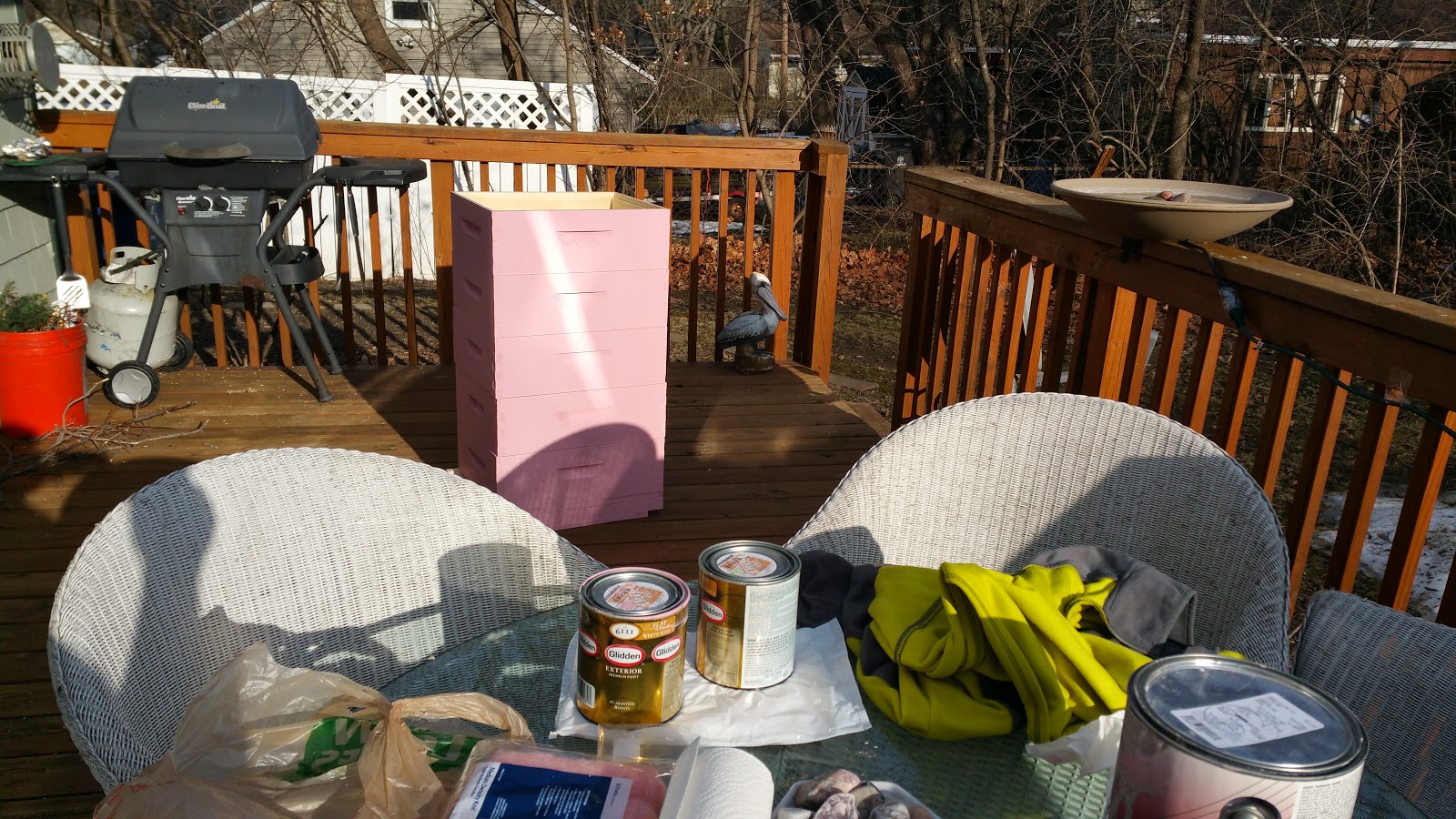
It was nearly 60 degrees yesterday afternoon so I finally hauled up all the boxes and painted them. Of course I'm still going to decorate them with stencils and all kinds of girly stuff, but this is a good start. 
Note the tree trunk in the background....*sigh* the condo association cut down all our shade, but it made for good painting.
That color is called "Pink Peonies" after my favorite flower.


Yes, the set on the right is the same color as my bathroom. 


I don't know where that pelican came from. He showed up on my deck sometime this winter.
There are only 53 more days until Bee Day, which coincidentally is Mother's Day. Instead of babies or cats, I'm going to be the mother of 80,000+ sweet little honey bees.